Maximize 2026 Education Tax Credits: AOTC & LLC Guide

Maximizing your education tax credits in 2026 involves understanding the American Opportunity Tax Credit (AOTC) and the Lifetime Learning Credit (LLC) to strategically reduce your tax liability for qualified educational expenses.
Navigating the complex world of tax credits can feel daunting, especially when it comes to educational expenses. However, understanding and effectively utilizing these benefits can lead to significant financial relief. This guide will help you in maximizing your education tax credits in 2026, specifically focusing on the American Opportunity Tax Credit (AOTC) and the Lifetime Learning Credit (LLC), providing practical solutions to lessen the financial impact of education.
Understanding the American Opportunity Tax Credit (AOTC)
The American Opportunity Tax Credit (AOTC) is a cornerstone for many students and families seeking to alleviate the financial strain of higher education. It’s a partially refundable credit, meaning that even if it reduces your tax liability to zero, you could still get 40% of the remaining credit back as a refund, up to $1,000. This makes it an incredibly valuable tool for those pursuing undergraduate degrees.
To qualify for the AOTC, stringent criteria must be met, ensuring the credit is directed towards those who genuinely need it for their initial years of college. The student must be pursuing a degree or other recognized educational credential, enrolled at least half-time for at least one academic period beginning in the tax year, and not have finished the first four years of higher education at the beginning of the tax year. Furthermore, the student cannot have claimed the AOTC or the former Hope credit for more than four tax years.
Eligibility requirements for AOTC
Meeting the eligibility requirements is crucial for claiming this beneficial credit. The student must be enrolled in a program leading to a degree, certificate, or other recognized educational credential. Enrollment must be at an eligible educational institution, which generally includes most accredited public, nonprofit, and private colleges, universities, and vocational schools.
- Student must be in their first four years of higher education.
- Must be enrolled at least half-time for at least one academic period.
- Cannot have a felony drug conviction on their record.
- Modified Adjusted Gross Income (MAGI) must be below certain thresholds.
The AOTC is designed to support students during their foundational years of higher education. Understanding these parameters is the first step towards successfully claiming this credit and reducing your overall educational costs.
Exploring the Lifetime Learning Credit (LLC)
While the AOTC focuses on the initial years of higher education, the Lifetime Learning Credit (LLC) offers a broader scope, supporting a wider range of educational pursuits. This credit is nonrefundable, meaning it can reduce your tax liability to zero, but you won’t receive any portion of the credit back as a refund. It’s an excellent option for those pursuing graduate studies, vocational training, or even just a few courses to improve job skills.
The LLC is more flexible regarding the type of education and the student’s academic status. There is no limit on the number of years you can claim the LLC, making it suitable for lifelong learners. Whether you’re taking a single course to enhance your professional skills or pursuing a master’s degree, the LLC can help offset some of those expenses. This flexibility is what sets it apart from the AOTC, catering to different educational journeys.
Who can claim the LLC?
The LLC has less restrictive enrollment requirements than the AOTC, making it accessible to a broader demographic of students. It can be claimed for undergraduate, graduate, or professional degree courses, or for courses taken to acquire job skills. The student does not need to be pursuing a degree or enrolled for a minimum number of credit hours.
- Available for undergraduate, graduate, or job skills courses.
- No limit on the number of years the credit can be claimed.
- Student does not need to be enrolled at least half-time.
- MAGI limitations apply, similar to the AOTC but with different thresholds.
The adaptability of the LLC makes it a vital resource for individuals at various stages of their educational and professional development. It ensures that continuous learning remains financially viable.
Key Differences and Similarities: AOTC vs. LLC
While both the AOTC and LLC aim to reduce the financial burden of education, they serve different purposes and have distinct eligibility criteria. Understanding these differences is crucial for choosing the credit that best suits your situation and for maximizing your education tax credits in 2026. Both credits require the student to be enrolled at an eligible educational institution and have income limitations, but their specifics diverge significantly.
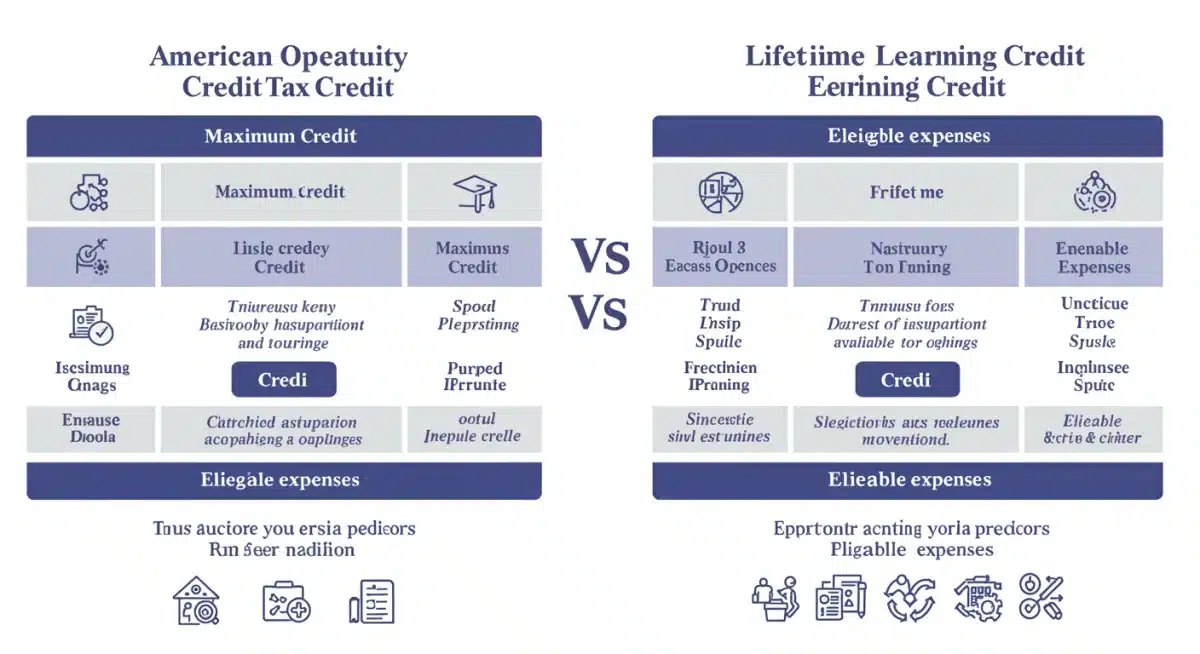
The AOTC is generally more generous, offering a maximum credit of up to $2,500 per eligible student, with up to $1,000 being refundable. It’s specifically for the first four years of postsecondary education. In contrast, the LLC offers a maximum credit of $2,000 per tax return, is nonrefundable, and can be claimed for an unlimited number of years for any level of postsecondary education or courses taken to acquire job skills.
Choosing the right credit for your situation
Deciding between the AOTC and LLC depends on several factors, including the student’s academic standing, the type of education being pursued, and the taxpayer’s income. It is important to note that you cannot claim both credits for the same student in the same tax year. Careful consideration of each credit’s benefits and limitations is necessary.
- AOTC: Best for undergraduate students in their first four years, enrolled at least half-time, seeking a more substantial, partially refundable credit.
- LLC: Ideal for graduate students, those taking a few courses, or pursuing job skill enhancement, offering flexibility over multiple years.
- Income Limits: Both have MAGI phase-outs, so check the specific thresholds for 2026.
Making an informed choice between these two credits can significantly impact your tax outcome. It’s about aligning the credit with your educational journey and financial circumstances.
Qualified Education Expenses for 2026
Understanding what constitutes a qualified education expense is fundamental to claiming either the AOTC or the LLC. The IRS has specific guidelines on what expenses can be included, and these can vary slightly between the two credits. Generally, these expenses are amounts paid for tuition, fees, and other related expenses required for enrollment or attendance at an eligible educational institution.
For the AOTC, qualified expenses include tuition, fees, and course-related books, supplies, and equipment that are required for enrollment or attendance, even if not paid directly to the educational institution. This broader definition for AOTC is designed to cover the essential costs associated with starting a college career. However, expenses for room and board, insurance, medical expenses, transportation, and similar personal, living, or family expenses are generally not considered qualified expenses.
What counts and what doesn’t?
When calculating your eligible expenses, precision is key. Keep meticulous records of all payments made to the educational institution and for required course materials. This documentation will be invaluable if your return is ever questioned by the IRS.
- Tuition and Fees: Always included for both credits.
- Books, Supplies, Equipment: For AOTC, these are qualified even if not purchased directly from the school. For LLC, they must be required for enrollment or attendance.
- Room and Board: Generally not qualified, though some exceptions might apply with institutional grants.
- Transportation and Personal Expenses: Never qualified for either credit.
Knowing exactly what expenses are eligible ensures you claim the maximum possible credit without issues. Always refer to IRS Publication 970 for the most current and detailed information.
Income Limitations and Phase-Outs for 2026
Both the American Opportunity Tax Credit and the Lifetime Learning Credit are subject to income limitations, meaning that as your Modified Adjusted Gross Income (MAGI) increases, the amount of credit you can claim begins to phase out. Eventually, if your MAGI exceeds a certain threshold, you may not be eligible for any credit at all. These thresholds are adjusted annually for inflation, so it’s important to be aware of the specific limits for the 2026 tax year.
For 2026, the MAGI phase-out ranges will be published by the IRS later. However, based on previous years, it’s safe to anticipate that single filers and married couples filing jointly will have different thresholds. Understanding where your income falls within these ranges is critical for strategic tax planning and accurately estimating your potential credit amount. Exceeding these limits can significantly reduce or eliminate your eligibility.
Navigating MAGI thresholds for optimal benefits
To effectively plan for maximizing your education tax credits in 2026, you should anticipate your MAGI for the tax year. If your income is close to the phase-out limits, consider strategies to reduce your MAGI, such as contributing to a traditional IRA or 401(k), if applicable. These actions could potentially bring your income within the eligible range or increase the portion of the credit you can claim.
- Single Filers: Typically, credits begin to phase out at a specific MAGI level and are completely phased out at a higher level.
- Married Filing Jointly: These thresholds are generally double those for single filers.
- Tax Planning: Review your income and potential deductions early in the year to optimize your MAGI.
Staying informed about the MAGI limits and proactive tax planning are essential steps to ensure you don’t miss out on these valuable education tax credits.
Strategies for Maximizing Your Education Tax Credits
Beyond simply understanding the credits, implementing effective strategies can significantly enhance your ability to reduce educational costs through tax benefits. Strategic planning involves not only knowing the rules but also making informed decisions throughout the academic year and during tax preparation. The goal is to leverage every available opportunity to minimize your tax burden and maximize your refunds or credits.
One key strategy is to ensure meticulous record-keeping. Keep all receipts and documentation related to tuition payments, fees, and qualified educational expenses. This includes Form 1098-T from your educational institution, which reports tuition payments. Having organized records will streamline the tax preparation process and provide necessary proof if the IRS ever questions your claims. Without proper documentation, even valid claims can be denied.
Advanced planning and considerations
Consider who claims the student as a dependent. If you claim a student as a dependent, only you can claim the education credit for their expenses. If the student is not your dependent, they may be able to claim the credit themselves. This decision can impact the overall tax benefit, especially if the student has a lower income and might benefit more from the refundable portion of the AOTC.
- Coordination with Dependents: Discuss with your student who will claim the credit for optimal benefit.
- Timing of Expenses: Sometimes, prepaying tuition for the first academic period of the next year in the current year can shift expenses to maximize a credit.
- Consult a Professional: For complex situations or high income, a tax professional can offer tailored advice.
- Stay Updated: Tax laws and credit details can change, so always refer to the latest IRS publications.
Proactive engagement with these strategies ensures that you are fully prepared to take advantage of all eligible education tax credits, thereby significantly easing your financial commitment to education.
Common Pitfalls and How to Avoid Them
While education tax credits offer substantial financial relief, navigating their complexities can lead to common mistakes that can result in denied claims or even penalties. Being aware of these pitfalls and understanding how to avoid them is just as important as knowing the benefits of the credits themselves. Many errors stem from misunderstanding eligibility requirements or failing to keep adequate records.
One frequent mistake is attempting to claim both the AOTC and LLC for the same student in the same tax year. As previously mentioned, this is not allowed. Taxpayers must choose one credit per student per year. Another common pitfall involves miscalculating qualified expenses, often including non-eligible items like room and board or transportation. This can lead to an incorrect credit amount and potential issues with the IRS.
Ensuring compliance and accuracy
Accuracy in reporting is paramount. Always double-check your entries against official documentation like Form 1098-T. If you receive a scholarship or grant, understand how it impacts your qualified expenses, as some grants may reduce the amount of expenses you can claim for the credit.
- Avoid Double Dipping: Do not claim both AOTC and LLC for the same student in the same year.
- Verify Qualified Expenses: Only include expenses explicitly allowed by the IRS for each credit.
- Impact of Scholarships/Grants: Understand how financial aid affects your eligible expenses.
- Accurate MAGI Reporting: Ensure your Modified Adjusted Gross Income is correctly calculated to avoid phase-out issues.
By diligently avoiding these common errors, you can ensure a smooth tax filing process and successfully claim the education tax credits you are entitled to, effectively maximizing your education tax credits in 2026.
| Key Point | Brief Description |
|---|---|
| American Opportunity Tax Credit (AOTC) | Up to $2,500, partially refundable, for first four years of postsecondary education. |
| Lifetime Learning Credit (LLC) | Up to $2,000, nonrefundable, for any level of postsecondary education or job skills courses. |
| Qualified Expenses | Tuition, fees, and required course materials. Room and board are generally excluded. |
| Income Limitations | Both credits have MAGI phase-out ranges, impacting eligibility and credit amount. |
Frequently Asked Questions About Education Tax Credits
No, you cannot claim both the American Opportunity Tax Credit (AOTC) and the Lifetime Learning Credit (LLC) for the same student in the same tax year. You must choose the one that provides the most benefit for your specific situation. This choice should be based on factors like the student’s academic level and the type of expenses incurred.
The specific income limits (Modified Adjusted Gross Income or MAGI) for 2026 will be released by the IRS. Generally, the credits begin to phase out for single filers and married couples filing jointly at different thresholds. It’s crucial to consult official IRS publications or a tax professional for the most up-to-date figures to ensure eligibility.
Generally, room and board expenses are not considered qualified education expenses for either the AOTC or the LLC. Qualified expenses primarily include tuition, fees, and certain course-related books, supplies, and equipment required for enrollment or attendance. Personal living expenses like housing are typically excluded from these credits.
Yes, you may be able to claim the Lifetime Learning Credit (LLC) if you are taking courses to acquire or improve job skills. Unlike the AOTC, the LLC does not require you to be pursuing a degree or enrolled at least half-time, making it ideal for professional development and continuing education.
To claim education tax credits, you will typically need Form 1098-T, Tuition Statement, from your educational institution. Additionally, it’s essential to keep records of all receipts and proof of payment for qualified educational expenses, including books and supplies. Accurate and thorough documentation is key for substantiating your claim.
Conclusion
Successfully maximizing your education tax credits in 2026 involves a clear understanding of the American Opportunity Tax Credit and the Lifetime Learning Credit, their respective eligibility criteria, and the types of expenses that qualify. By carefully planning, maintaining meticulous records, and staying informed about IRS guidelines, students and families can significantly reduce the financial burden of higher education. These credits are powerful tools for financial relief, and leveraging them effectively requires diligence and informed decision-making. Don’t leave money on the table; take the time to understand and apply these critical tax benefits.